
|
|
 |
|
 |
Navigation: Contents: Info: THE
LOCATION OF CEPHEIDS IN THE GALAXY AND ON THE
H-R
DIAGRAM
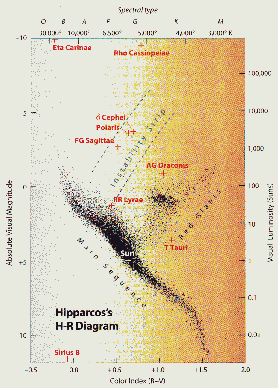
Shown below is the
latest version of the Hertzsprung - Russell diagram. It was
put together using the latest data from the Hipparcos and
Tycho mission. H-R diagram using data
from the Tycho and Hipparcos
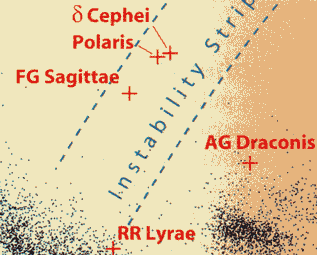
mission As can be seen in this enlargement
below, the Cepheids (and other types of variable star) lay
in a zone called the instability strip. The instability strip on the
Hertzsprung-Russell diagram is sharply defined. All stars
that begin life with about 5 to 20 solar masses eventually
pass through this zone, some more than once. What if a star
was balanced on the edge of this zone? Polaris is probably
the least recognised Cepheid variable with a magnitude
difference of only a tenth of a magnitude and a period of
3.97 days. Over the past 100 years it's pulsation's have
decreased to such an extent, its variability is only just
recognised. However Doppler measurements confirm that the
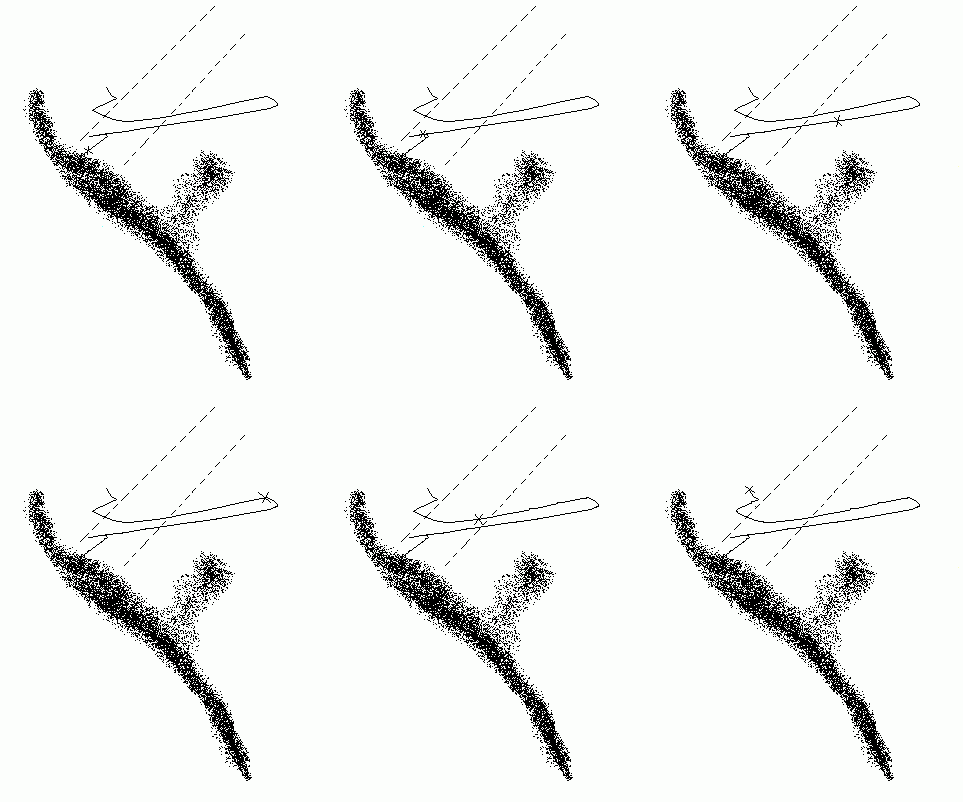
star still undergoes radial pulsation's. Here can be seen the path of a nine
solar mass star as it passes through the instability
strip The edges of the
instability strip The Blue
Edge Regions of larger optical depth are
more efficient in generating excitation or damping. For low
optical depth, the radiation can escape more easily and any
temperature differences are most easily smoothed out. If the
excitation region moves closer to the surface for stars with
increasing effective temperatures the pulsation
instabilities ceases. This determines the blue edge of the
instability strip. The Red
Edge We have seen that the excitation by
the k-mechanism is due to the increase in opacity, which
leads to a trapping of the radiative energy, which in turn
leads to an increase in temperature. This can only happen if
there is a radiative flux which can be trapped by an
increase in opacity. If most of this energy is transported
by convection, then an increase in the opacity will not trap
this energy. If there is efficient convective energy
transport, the excitation mechanism cannot work. Pulsation's
can only occur when there is an inefficiency in the
convective energy transport in the regions of increasing
opacity. This occurs at the boundary line for the onset of
efficient convection, this is exactly where we find the
Cepheid variables on the Hertzprung-Russell
diagram. Populations of
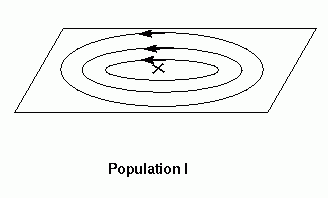
Stars Population I A name given to stars that are young,
metal rich and have low velocity relative to the sun. These
stars are confined to the galactic disk and have low
inclined orbits about the galactic center. They have high
metallically due to material obtained from previous
generations neucleosynthesis. Some examples of these stars
are main sequence stars and open clusters. The relative motions of
Population I stars around the galactic
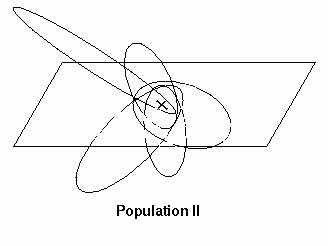
center Population II Opposite to Population I stars, these
are old, metal poor and have high velocity. They exhibit
orbits that are very elliptical and highly inclined to the
galactic plane. It is thought that these stars formed before
the galaxy contracted to its present flat structure and
before the interstellar medium was enriched with heavy
elements. The relative motions of
Population II stars around the galactic
center
[ QUANTUMWEB SOFTWARE | QUANTUMWEB PUBLISHING ]