
|
|
 |
|
 |
Navigation: Contents: Info: CEPHEIDS
IN OUR GALAXY AND THE MAGELLANIC
CLOUDS Classical
Cepheids These make up the Population I stars
in our galaxy. 90% of them are situated at less than 100
parsecs from the galactic plane. There are non at all beyond
a distance of 300 parsecs. The majority of them are young
stars and many, especially the long period Cepheids, are
associated with hydrogen clouds in the galactic arms.
However the Classical Cepheids with the shorter periods tend
to occur in large numbers in the outer regions of the
galaxy, such as the Cassiopeia, Orion and the Canis
Major-Puppis regions. The Classical Cepheids with longer
periods occur more in the arms nearer the galactic center in
areas such as the Carina-Centaurus, Vela and Sagittarius
regions. Short period Classical Cepheids are often
associated with galactic clusters, for example, U Sgr is in
the cluster Messier 25. Some long period Classical Cepheids
belong to O associations and so are very young stars, this
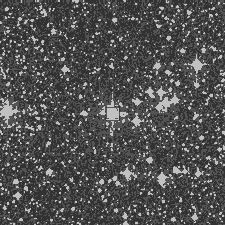
is the case with U Car. Photograph showing U
Sgr CW
Cepheids These make up the Population II stars.
The short period CW Cepheids are found towards the galactic
longitude of 180 degrees, whereas the long period stars are
found in the direction of the galactic center. Some CW
Cepheids are found in globular clusters but their light
curves are similar to those found in the galactic
halo. Cepheids In The Small
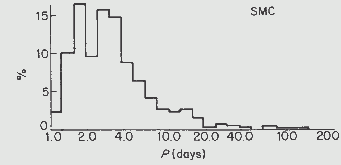
Magellanic Cloud Like our galaxy, there are two peaks
on the histogram for the Small Magellanic Cloud, one between
1.5 and 2 days, the other between 2.5 and 4 days. The
periods then are much shorter than they are in our galaxy.
The SMC comprises of both Population I and II stars with the
short period Cepheids near the outside, much like they are
in our own galaxy, and the longer period stars concentrated
near the central regions. Histogram showing the
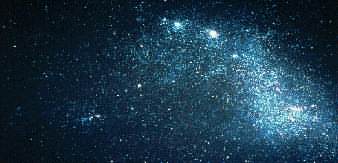
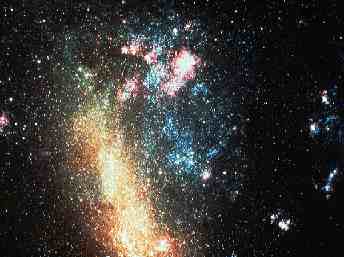
statistics for Cepheids in the SMC. Photograph of the
SMC. Cepheids In The Large
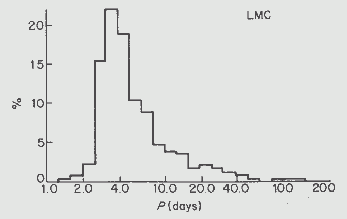
Magellanic Cloud The histogram for the Large Magellanic
Cloud is much different to the Small Magellanic Cloud. There
is only one peak at around 3 to 4 days. The LMC comprises of
mainly Population I stars, so those on the diagram below are
mostly Classical Cepheids. There are many short period stars
in the central region, whereas the longer period stars tend
to lie in the outskirts. Histogram showing the
statistics for Cepheids in the LMC. Photograph of the
LMC.
[ QUANTUMWEB SOFTWARE | QUANTUMWEB PUBLISHING ]